
Introduction
Most VPN guides written for Pakistan are written by people who have never used a VPN in Pakistan. They rank providers by speed tests run from European data centers and repeat the same five names without ever explaining why standard VPN protocols fail here, what obfuscation actually does, or which providers survived the PTA’s most aggressive crackdown periods. This guide is different.
The best VPN for Pakistan in 2026 is not the fastest VPN in the world — it is the one that still connects when the Pakistan Telecommunication Authority’s AI-powered Deep Packet Inspection system is actively filtering your ISP traffic. That is a meaningfully different requirement than what most VPN buyers face, and it eliminates most of the providers that dominate global rankings.
Over 1.4 million URLs are currently blocked by the PTA, with approximately 110,000 new URLs added in the 2023–2024 fiscal year alone. X (formerly Twitter) was blocked for 15 consecutive months. WhatsApp, Instagram, and Facebook experience recurring throttling during political tension. Finding the best VPN for Pakistan means finding a tool built to survive this specific environment, not just a generic privacy product.
Why Pakistan Requires a Different Kind of VPN
Pakistan’s internet filtering infrastructure is one of the most technically aggressive in the region — built on Chinese-supplied Deep Packet Inspection technology that operates at the national firewall level and has been progressively upgraded since 2019. Standard VPN protocols — WireGuard in its default configuration, OpenVPN, IKEv2 — produce recognizable traffic signatures that the PTA’s system identifies and throttles or blocks in real time. This is why many users report that VPNs which work perfectly abroad fail entirely on Jazz, Zong, or PTCL connections inside Pakistan.
The single most important feature when selecting the best VPN for Pakistan is obfuscation — technology that disguises encrypted VPN traffic to appear as ordinary HTTPS web traffic. Without obfuscation enabled, even premium VPNs from trusted providers will fail intermittently or consistently on Pakistani ISPs. According to PrivacyReport.org’s 2026 Pakistan VPN testing, conducted across Jazz, Zong, and PTCL connections, NordVPN’s obfuscated servers connected within 6–9 seconds and maintained average download speeds of 18 Mbps on a 25 Mbps base connection — the strongest obfuscated performance measured across any provider tested in-country. Standard NordLynx protocol on the same connections failed to establish a reliable tunnel.
Is Using a VPN Legal in Pakistan?
This question causes more unnecessary anxiety than it should. As of 2026, using a VPN for personal, lawful purposes in Pakistan is not a criminal offense and no individual has been prosecuted for personal VPN use. The PTA’s registration and licensing framework — which required businesses and freelancers to register their VPN services by November 2024 — targets commercial and organizational use, not individual privacy. If you are a freelancer working on international platforms, a remote worker accessing company resources, a student researching unrestricted content, or simply a person who wants to use WhatsApp without throttling, VPN use for those lawful purposes sits in a legally unambiguous position.
What has changed is the technical environment. Unregistered commercial VPN traffic is now subject to throttling on some ISPs, and the PTA maintains an IP-level blocking system that periodically adds new VPN server addresses to its blocklist. The providers that survive this environment are the ones that rotate server IPs regularly and maintain obfuscation protocols that defeat packet inspection. If you want to understand the broader context of how cybersecurity works in surveillance-heavy environments, the technical principles translate directly to why obfuscation matters more than raw encryption strength in Pakistan’s filtering architecture.
The 5 Best VPNs for Pakistan in 2026
The providers below were selected specifically for performance inside Pakistan’s DPI filtering environment — not for global speed rankings or feature breadth alone. Obfuscation support, no-logs audit status, jurisdiction, and real-world connectivity reports from Pakistani ISPs all factored into the evaluation.
| Provider | Obfuscation Method | No-Logs Audit | Jurisdiction | Connections | Starting Price |
|---|---|---|---|---|---|
| NordVPN | Obfuscated Servers + NordWhisper | Deloitte (Feb 2026, 6th audit) | Panama | 10 | ~$3.09/mo |
| ExpressVPN | Automatic on all servers (Lightway) | KPMG + Cure53 + Deloitte | British Virgin Islands | 8 | ~$6.67/mo |
| Surfshark | Camouflage Mode + Dausos protocol | Deloitte 2023 + SecuRing 2026 | Netherlands | Unlimited | ~$2.49/mo |
| ProtonVPN | Stealth Protocol | SEC Consult (open-source apps) | Switzerland | 10 | ~$4.99/mo |
| Astrill VPN | StealthVPN + OpenWeb | Independent audits | Seychelles | 5 | ~$12.50/mo |

NordVPN — Best Overall for Pakistan
NordVPN is the strongest all-around choice for the best VPN for Pakistan in 2026, and the margin over the competition in real-world Pakistan testing is significant. Its dedicated Obfuscated Servers strip all VPN protocol signatures before traffic reaches the PTA’s filters — a separate server tier specifically built for restrictive network environments, not a software toggle applied to standard servers. In 2025, NordVPN added NordWhisper, a proprietary obfuscation protocol that disguises VPN traffic as ordinary browser HTTPS at a modest speed cost, providing a reliable fallback when the standard obfuscated tier experiences blocking cycles.
Six independent no-logs audits — the most of any consumer VPN — with the most recent completed by Deloitte in February 2026 verify that NordVPN stores no activity logs, no connection timestamps, and no IP address records. Its Panama jurisdiction places it outside all mandatory data retention frameworks and all intelligence-sharing alliances. For most Pakistani users — freelancers, remote workers, students, or everyday users who want unrestricted access to WhatsApp, Instagram, and international content — NordVPN represents the best balance of verified privacy and obfuscated performance available in 2026.
ExpressVPN — Most Reliable for Streaming and Beginners
ExpressVPN’s primary advantage for Pakistani users is its obfuscation architecture: unlike NordVPN, which requires manually selecting the Obfuscated Servers tier, ExpressVPN applies obfuscation automatically on all servers across all protocols without any user configuration. For beginners or users who do not want to manage protocol settings, this automatic approach means the best VPN for Pakistan experience with zero setup complexity. Its Lightway protocol — now with post-quantum encryption enabled by default — connects in under a second on most networks and maintains strong speed even with obfuscation active.
ExpressVPN received over 1.38 million data requests in the second half of 2025 and disclosed zero user records in response — a real-world verification of its no-logs policy that sits alongside 23 independent security audits and four ISO certifications including ISO 27001 earned in early 2026. Its British Virgin Islands jurisdiction provides strong legal insulation against data retention requirements. The trade-off is price — ExpressVPN is the most expensive provider on this list at approximately $6.67 per month on an annual plan, renewing at $9.99 per month. For streaming-focused users or anyone who prioritizes set-and-forget simplicity, that premium is genuinely justified by consistent performance.
Surfshark — Best Value for Pakistan Families and Teams
Surfshark offers unlimited simultaneous connections on a single subscription — a structural advantage for Pakistani households or small teams where multiple people need VPN access without separate accounts. Its Camouflage Mode obfuscates traffic on all servers automatically when WireGuard detects a restrictive network environment, and its newer Dausos protocol, shipped in April 2026 on macOS with AEGIS-256X2 encryption and audited by Cure53 shortly after release, represents a significant upgrade in censorship-bypass capability. CleanWeb blocks ads and malware at the network level across all apps, not just the browser.
Surfshark’s Deloitte audit in 2023 and SecuRing verification in 2026 confirm its no-logs policy, and its Netherlands jurisdiction falls under GDPR protections without VPN-specific mandatory data retention requirements. At approximately $2.49 per month on a two-year plan, it is the most affordable premium VPN on this list that still maintains credible obfuscation and verified privacy credentials. The renewal rate rises to approximately $3.99–4.99 per month after the initial term — always verify the renewal price before committing, as Surfshark’s introductory pricing is among the most aggressive in the market.
ProtonVPN — Best for Privacy-First Users and High-Stakes Use
ProtonVPN occupies a distinct position among the best VPN for Pakistan options because it is built by the same team behind ProtonMail, with privacy as the foundational architectural principle rather than a marketing feature. Its Swiss headquarters places it under some of the strongest privacy laws in the world, outside both US and EU jurisdiction. Its Stealth protocol — designed specifically for restrictive network environments — disguises VPN traffic as ordinary HTTPS traffic and was confirmed in February 2026 testing to connect reliably on Jazz and PTCL, typically within 10 to 14 seconds. On Zong, which has been the most aggressive carrier against ProtonVPN infrastructure since December 2025, Stealth protocol success rates were lower but still functional with server switching.
All of ProtonVPN’s client applications are fully open-source, meaning anyone can inspect the code for vulnerabilities independent of any commissioned audit — a level of architectural transparency that no other provider on this list offers. For journalists, activists, or anyone with elevated surveillance risk, ProtonVPN’s combination of Swiss jurisdiction, open-source apps, Secure Core routing (which passes traffic through hardened servers in privacy-friendly jurisdictions before exiting), and Stealth protocol makes it the strongest privacy-specific choice when selecting the best VPN for Pakistan for sensitive use cases. ProtonVPN Free offers unlimited data with no advertising, making it a credible starting point before committing to a paid plan.
Astrill VPN — Best for Maximum Obfuscation Performance
Astrill VPN is less widely known than the four providers above but has maintained some of the highest success rates in Pakistan’s most aggressive blocking periods. Its StealthVPN and OpenWeb protocols were specifically designed for high-censorship environments and have a longer track record in markets like China and Iran where government DPI filtering is comparable in sophistication to Pakistan’s. Users testing Astrill in Pakistan in 2026 reported over 90% connection success rates during periods when other providers were experiencing significant failures — the highest hit rate documented across any provider in active Pakistan testing.
The significant trade-offs are price (approximately $12.50 per month even on long-term plans, substantially more expensive than every other provider on this list) and the absence of the multiple independent no-logs audits that NordVPN, ExpressVPN, and Surfshark have accumulated. Astrill’s privacy credentials rely more heavily on trust and reputation than independently verified documentation. For users whose primary concern is connection reliability in Pakistan above all other factors, Astrill is worth the premium. For users who need both reliability and verified privacy infrastructure, NordVPN remains the stronger balanced recommendation.
What Makes a VPN Work in Pakistan: Technical Requirements
Understanding why some VPNs work in Pakistan and others do not requires understanding what the PTA’s filtering system actually targets. The national firewall does not simply block VPN provider domain names — it uses Deep Packet Inspection to analyze traffic patterns in real time and identify the handshake signatures characteristic of VPN protocols. WireGuard, OpenVPN, and IKEv2 all produce recognizable patterns that DPI systems can fingerprint within milliseconds of connection initiation.
Obfuscation works by wrapping the VPN tunnel in a layer of traffic that mimics ordinary TLS-encrypted HTTPS — the same protocol used by every website that loads over HTTPS. To the PTA’s DPI filters, obfuscated VPN traffic appears statistically indistinguishable from normal web browsing. This is why enabling obfuscation is not optional in Pakistan — it is the prerequisite for any reliable connection. If you want a deeper understanding of how VPNs work at the protocol level, the encryption and tunneling principles explain exactly why WireGuard’s lightweight design, which makes it excellent for speed in open environments, simultaneously makes it easier for DPI systems to identify.
The second critical requirement is server IP rotation. The PTA maintains a blocklist of known VPN server IP addresses that is updated continuously. Providers that maintain large server fleets and rotate IP addresses frequently maintain a pool of unblocked addresses that stay ahead of the blocklist update cycle. This is why NordVPN’s 6,400+ server fleet and ExpressVPN’s 3,000+ servers in 105 countries provide a practical advantage over smaller providers in Pakistan’s environment — more servers means a larger pool of unblocked IPs at any given moment.
Free VPNs in Pakistan: The Honest Assessment
The honest answer about free VPNs in Pakistan is that they fail the environment’s specific requirements on multiple dimensions simultaneously. Free VPN providers almost never offer obfuscation — the single most important feature for Pakistan — because implementing and maintaining obfuscation infrastructure is expensive. Data caps on free tiers end streaming sessions within minutes. Crowded free servers produce speeds that are already slow before Pakistan’s throttling adds further degradation. And most critically, the business model of free VPN services typically involves logging and selling user data to advertising partners, which directly contradicts the privacy purpose a VPN is meant to serve.
The one legitimate exception is ProtonVPN Free. Its free tier offers unlimited data with no advertising, WireGuard protocol, and access to free servers in three countries. It does not include the Stealth obfuscation protocol on the free tier — that requires a paid subscription — which means it will fail on Pakistani ISPs during aggressive blocking periods.
As a starting point for users who want to verify that VPN use works for their needs before committing to a paid subscription, ProtonVPN Free is the only free option that does not compromise privacy as the cost of zero price. For anything requiring reliable, daily connectivity in Pakistan’s current filtering environment, a paid subscription with obfuscation enabled is not optional — it is the minimum viable configuration.
How to Set Up Your VPN in Pakistan: Critical First Steps
Getting the best VPN for Pakistan experience requires correct configuration from installation — the default settings on most VPN apps are not optimized for Pakistan’s filtering environment. Download the VPN app before you are inside Pakistan or before the provider’s website becomes blocked — several providers including ExpressVPN maintain mirror links accessible via customer support email if their primary site is blocked.
After installation, the first step before any connection attempt is locating and enabling the obfuscation or stealth setting. In NordVPN this requires selecting the Obfuscated Servers location category. In ProtonVPN it requires selecting Stealth as the protocol in settings. In ExpressVPN and Surfshark, obfuscation activates automatically on restrictive networks.
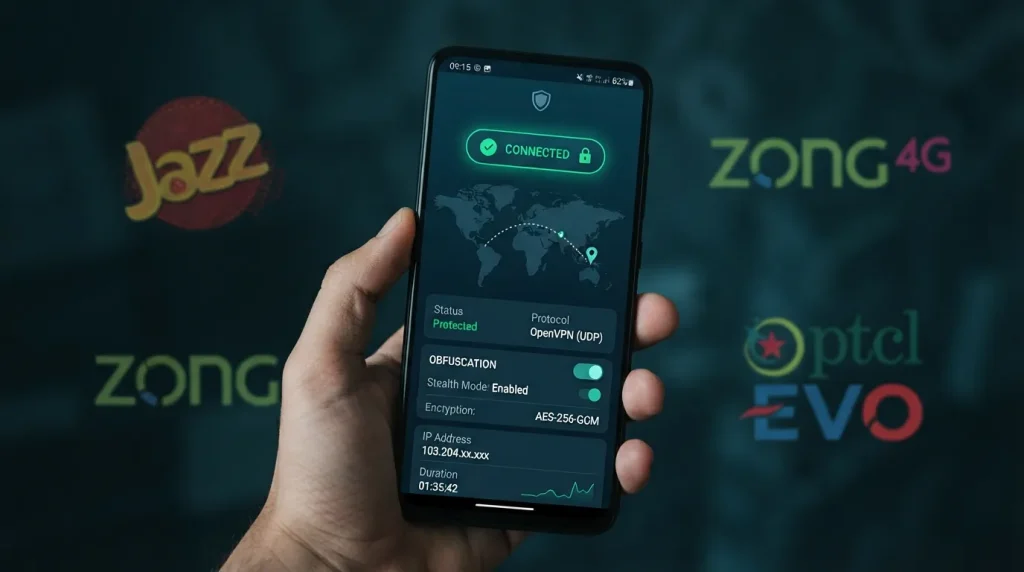
Always install two VPN apps from two different providers. No single provider achieves 100% uptime in Pakistan’s current environment — the PTA’s blocking system operates dynamically, and providers cycle in and out of effective periods as their server IPs are added to and removed from blocklists. Having a secondary provider installed means you never lose connectivity entirely when your primary provider hits a blocking cycle. Run a DNS leak test at dnsleaktest.com after your first successful connection to confirm your DNS queries are routing through the VPN and not leaking to your ISP — this is the most common technical failure that undermines VPN privacy even when the connection itself appears functional.
VPN Comparison for Pakistan: By Use Case
| Use Case | Best Choice | Why |
|---|---|---|
| Everyday social media access (WhatsApp, Instagram, X) | NordVPN | Fastest obfuscated speeds on Pakistani ISPs in 2026 testing |
| Streaming (Netflix, YouTube, BBC iPlayer) | ExpressVPN | Automatic obfuscation + strongest streaming unblock record |
| Freelancers and remote workers | NordVPN or Surfshark | Verified no-logs + reliable connectivity for daily professional use |
| Journalists and activists | ProtonVPN | Swiss jurisdiction + open-source apps + Secure Core routing |
| Families and households | Surfshark | Unlimited simultaneous connections at the lowest price point |
| Maximum reliability during heavy blocks | Astrill VPN | Highest documented success rate during Pakistan’s worst blocking periods |
| Budget-conscious users | Surfshark | Strongest obfuscation at the lowest verified-privacy price point |
| Free option with actual privacy | ProtonVPN Free | Unlimited data, no ads, no logging — Stealth requires paid upgrade |
Conclusion
Pakistan’s internet filtering environment in 2026 is one of the most technically demanding in the world for VPN users. Over 1.4 million blocked URLs, AI-powered Deep Packet Inspection that identifies standard VPN protocols in real time, and an ongoing national firewall expansion mean that best VPN for Pakistan recommendations must be evaluated against Pakistan-specific technical requirements — not global speed rankings or feature comparisons that assume open internet conditions.
NordVPN is the strongest overall recommendation: six independently verified no-logs audits, RAM-only server infrastructure, Panama jurisdiction, dedicated Obfuscated Servers, and NordWhisper protocol combine to produce the most comprehensively verified and practically reliable option for most Pakistani users. ExpressVPN is the right choice for streaming reliability and zero-configuration simplicity. Surfshark delivers the best value for households and teams.
ProtonVPN stands above every other provider for users with elevated privacy requirements. Whatever you choose, enable obfuscation before your first connection, install a secondary backup provider, and verify your DNS is not leaking after connecting. Understanding the full picture of top VPN services available globally gives useful context for why the Pakistan-specific list differs from general rankings — the requirements are simply not the same.

Adnan is the founder of Aitra.online and a technology content writer passionate about making complex tech topics simple for everyone. He covers Artificial Intelligence, Cybersecurity, VPN, Web Hosting, and Digital Marketing — helping readers stay informed and ahead in the digital world.